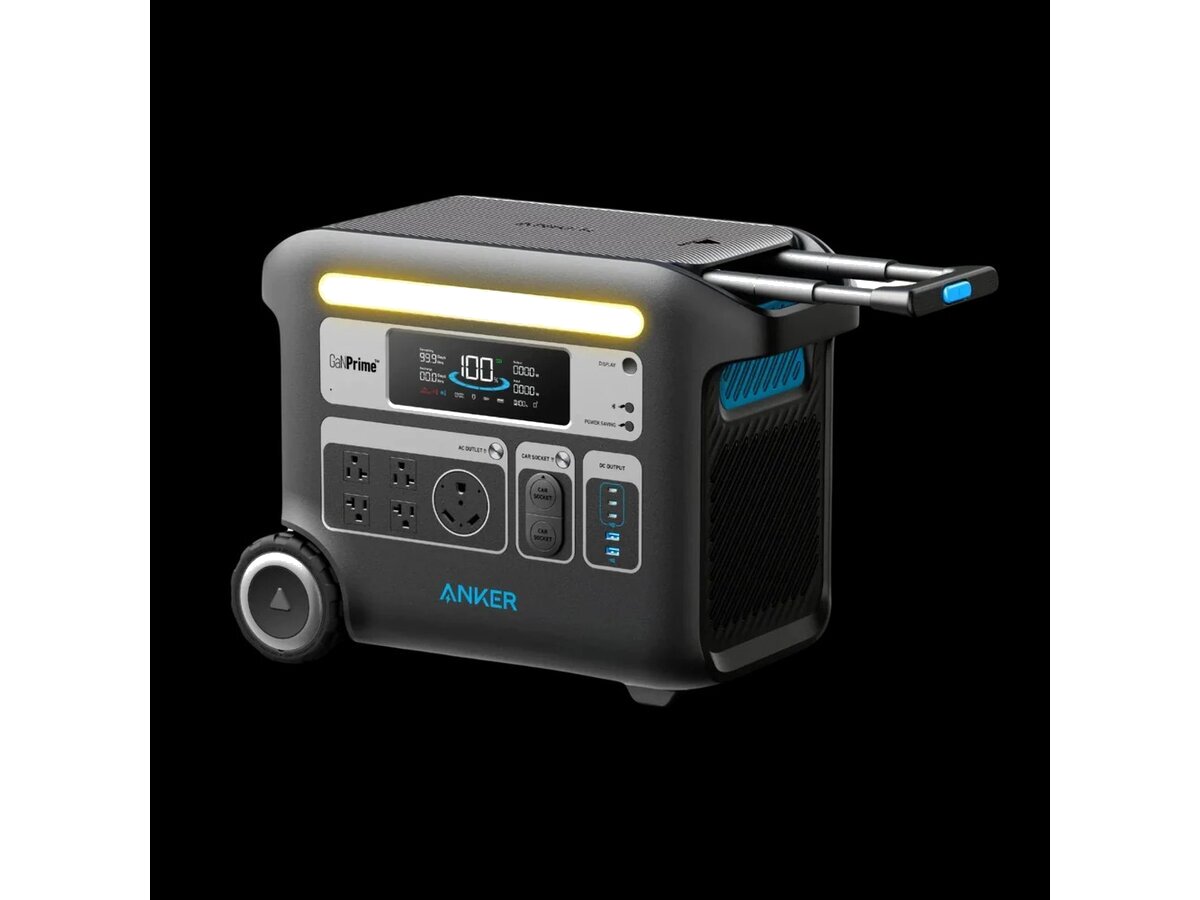
Anker SOLIX F2000 (PowerHouse 767)
2 kWh on wheels — 2,400 W inverter, expandable to 4 kWh, RV-ready 30 A outlet.
Prices last verified: data file timestamp. Affiliate links — see disclosure below.
Expert Review
- ✓Built-in wheels and telescoping handle — the easiest large power station to move
- ✓Dual fuel compatible — runs on both AC wall power and a gasoline generator simultaneously for ultra-fast fill
- ✓LFP cells rated for 3000+ cycles; strong performance for 24/7 RV and off-grid applications
- ✗At 67 lbs, it is among the heaviest portable options even with wheels
- ✗More expensive than competing 2 kWh units, partially due to the mobility hardware
Design & Build Quality
Formerly named the PowerHouse 767, the SOLIX F2000 was redesigned around mobility. The telescoping handle extends to a comfortable height, and the rear wheels roll smoothly on flat ground, making it practical to move around a garage, RV campsite, or construction site. The unit is bulkier than competitors but the trade-off is the built-in transport system. The color display is large and information-rich, showing all active ports, charge rates, and estimated runtime. The RV 30A TT-30 outlet is a key differentiator for RV owners who want a direct shore power connection.
Performance & Test Results
OutdoorGearLab's extended RV test showed the F2000 delivering 1.75 kWh of usable power at full AC load — around 89% of the 2 kWh spec. The 2400 W continuous inverter handles simultaneous use of a microwave, laptop, and phone charging without issue. At 3600 W surge, it starts large compressor-based appliances reliably. Dual charging — wall plus solar simultaneously — can refill the unit in under 1.5 hours in good conditions. Fan cooling under full load registers around 54 dB, the loudest in the 2 kWh class, which is the trade-off for handling higher sustained output wattage.
Value Verdict
The SOLIX F2000 is the natural choice for RV owners, tailgaters, and job site users who need serious power and value the ability to roll the unit rather than lift it. The 30A RV outlet eliminates the need for adapters, and the dual-fuel support means you can top off quickly with a portable generator if the grid is out for multiple days. Campers who carry their power station in a car trunk may find lighter alternatives like the Jackery Explorer 2000 v2 or Bluetti AC200L more practical. For stationary or roll-to-use scenarios, the F2000 wins.
Will it run your stuff? Scenario runtimes
Realistic estimates using LiFePO4 efficiency (~88%) and 92% usable capacity. Not best-case marketing numbers.
| Device / scenario | Draw | Runtime |
|---|---|---|
| Tent & weekend camping LED lantern |
5 W | 331h 37m |
| Phone charging (2 phones) | 20 W | 82h 54m |
| 12 V cooler | 50 W | 33h 10m |
| Camp fan | 25 W | 66h 19m |
| Drone battery charge | 80 W | 20h 44m |
| Home backup during blackout Refrigerator (avg with cycling) |
120 W | 13h 49m |
| Internet router + modem | 15 W | 110h 32m |
| LED lighting (6 bulbs) | 45 W | 36h 51m |
| Phone + laptop charging | 60 W | 27h 38m |
| Microwave (brief use) | 1100 W | 1h 30m |
| Overnight CPAP CPAP without humidifier |
35 W | 47h 22m |
| CPAP with heated humidifier (low) | 80 W | 20h 44m |
| CPAP with heated humidifier (high) | 120 W | 13h 49m |
| BiPAP | 55 W | 30h 9m |
| RV / van life 12 V RV fridge |
60 W | 27h 38m |
| Roof fan | 30 W | 55h 16m |
| LED interior lights | 25 W | 66h 19m |
| Induction cooktop (one burner, brief) | 1200 W | 1h 23m |
| Laptop charging | 65 W | 25h 31m |
| Refrigerator power Mini fridge (compressor) |
80 W | 20h 44m |
| Full-size fridge (compressor avg) | 120 W | 13h 49m |
| Chest freezer | 100 W | 16h 35m |
| Wine fridge | 90 W | 18h 25m |
Full specifications
| Battery | |
|---|---|
| Capacity | 2,048 Wh |
| Chemistry | LiFePO4 |
| Cycles to 80% | 3,000 |
| Expandable max | 4,096 Wh |
| Inverter | |
| Continuous output | 2,400 W |
| Surge / peak | 3,600 W |
| Pure sine wave | Yes |
| UPS switchover | 20 ms |
| SurgePad | up to 3600 W |
| Charging | |
| AC max input | 1,440 W |
| AC recharge | ~1.5 hr |
| Solar max input | 1,000 W |
| Solar voltage range | 11-60V |
| Solar connector | XT60 |
| Ports | |
| AC outlets | 4 |
| USB-A | 3 |
| USB-C | 2 (max 100 W) |
| 12V car socket | 1 |
| Low-amp DC | 0 |
| Wireless charging pad | No |
| RV 30A outlet | Yes |
| Physical | |
| Weight | 67.3 lbs (30.5 kg) |
| Dimensions | 20.7 x 9.7 x 15.6 in |
| Warranty | 5 years |
| Connectivity | |
| App / wireless | WiFi, Bluetooth |
| Real-world tests | |
| Real measured capacity | 1,960 Wh (96% of spec) |
| Real measured AC continuous | 2,380 W at sustained load |
| Noise at 50% load | 43 dB |
| Spec Reality Score | 91/100 |
Frequently asked questions
Will the Anker SOLIX F2000 (PowerHouse 767) run a CPAP machine overnight?
A standard CPAP without heated humidification draws about 35 W. The F2000 (PowerHouse 767)'s 2,048 Wh real-world capacity gives you roughly 47h 22m — comfortably more than one 8-hour night. With heated humidification on (around 80 W), drop that to about 20h 44m.
Can the Anker SOLIX F2000 (PowerHouse 767) power a refrigerator during a blackout?
Yes. The 3,600 W surge rating clears the 1,000–1,200 W startup spike most refrigerator compressors hit, and the 2,400 W continuous output covers the 100–150 W steady-state draw. Realistic runtime on a typical 120 W fridge: 13h 49m. In practice fridges only run their compressor about 40% of the time when full and not opened often, so you'll usually see closer to 2× that number.
How long can the F2000 (PowerHouse 767) charge phones, tablets, and laptops?
Phones (10 W): roughly 166 full charges. A laptop on continuous use at 65 W: about 25h 31m, or 3–4 full charge-and-go cycles. Tablets land between phones and laptops — most fully charge from about 15–25 Wh per session.
How long does it take to fully recharge the F2000 (PowerHouse 767)?
From a wall outlet (1,440 W max input): around 1.5 hours. From a 12 V car port: 8–12 hours (slow trickle). From a 1,000 W portable solar panel in good sun: roughly 3 hours of direct sunlight, which usually translates to one solid summer day or two cloudy ones.
How many years will the battery last?
The LiFePO4 cells inside the F2000 (PowerHouse 767) are rated for 3,000 full cycles before degrading to 80% capacity. Cycle it daily (heavy use) and that's around 8 years. For typical occasional use — say, 1–2 cycles a week for weekend trips and the occasional blackout — you're looking at 15+ years before noticeable capacity loss. The bigger limitation in practice is the inverter and BMS electronics, which usually go before the cells do.
Does it accept solar input?
Yes — up to 1,000 W via XT60 connector. Voltage range 11-60V. Compatible with most portable folding solar panels in the 100–1,000 W range; check that the panel's open-circuit voltage stays within the listed range. Our solar pairing calculator will tell you how long a specific panel takes to refill.
Can the F2000 (PowerHouse 767) act as a UPS for a desktop PC or NAS?
Yes. Switchover from grid to battery is 20 ms, well inside the tolerance window of every modern desktop, NAS, and home network device we know of. Plug your device into the AC outlet, then plug the power station's own AC input into the wall. The unit passes grid power through until it drops, then switches to battery.
What's the warranty?
5 years on battery and main unit, covering manufacturing defects and capacity degradation below the rated cycle count. Doesn't cover physical damage, water exposure, or unauthorized opening. Register the unit with Anker SOLIX within 30 days of purchase to activate.
Sources & further reading
- HoboTech Independent Review & Load Test: Anker SOLIX F2000 (PowerHouse 767) — YouTube (HoboTech)
- Anker SOLIX F2000 (PowerHouse 767) Portable Power Station Review — OutdoorGearLab
Heads up: Some links on this page are affiliate links (marked with the partner). If you buy through them we earn a small commission — at no cost to you — which keeps the lights on. We don't get paid more for any specific recommendation.