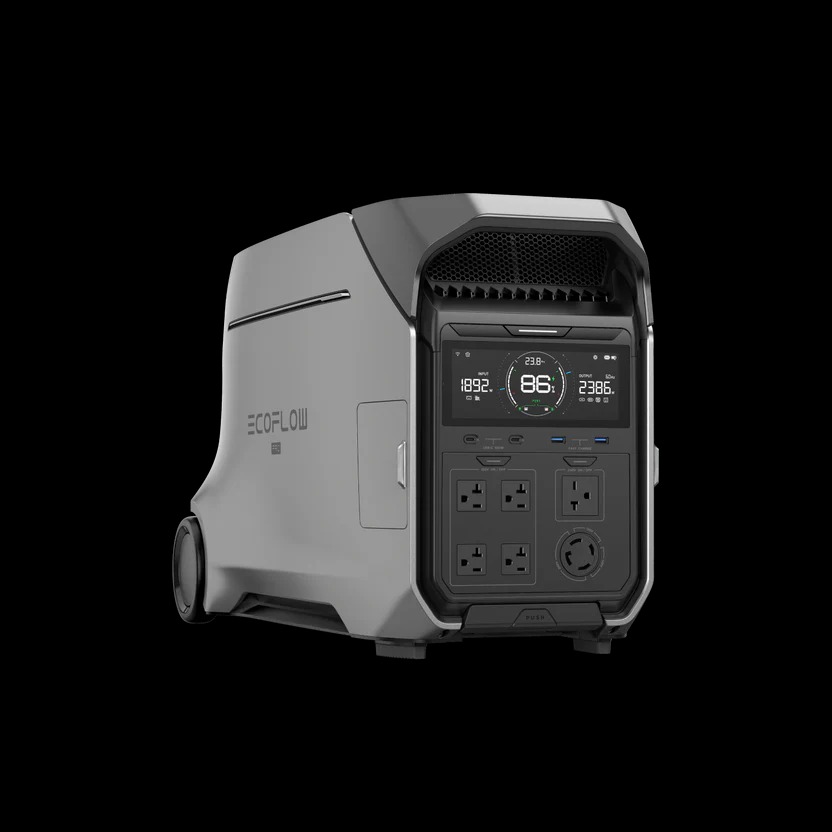
EcoFlow DELTA Pro 3
Whole-home backup class — 4 kWh, 4 kW continuous, expandable to 48 kWh.
Prices last verified: data file timestamp. Affiliate links — see disclosure below.
Expert Review
- ✓Massive 4000 W pure sine inverter handles central AC, well pumps, and power tools simultaneously
- ✓120V/240V split-phase output — can connect directly to a home transfer switch
- ✓Expandable up to 12 kWh with external battery packs; built-in smart home integration
- ✗Expensive — typically $3,000+ before expansion batteries
- ✗Heavy at 90+ lbs; requires the included wheel kit for any practical mobility
Design & Build Quality
The Delta Pro 3 is unambiguously large. EcoFlow designed it to live in a utility room or garage corner rather than be hauled to a campsite. The telescoping handle and recessed wheels are solid and well-integrated — rolling it across a garage floor or down a hallway is manageable for one person. The front panel is a full-color touchscreen showing energy flow diagrams, solar input, and state of charge by percentage and kWh. Multiple AC outlets are grouped on the back, and the 30A RV outlet is conveniently labeled. The overall build quality feels commercial-grade, not consumer toy.
Performance & Test Results
Reviewer consensus places the Delta Pro 3 in a class of its own for home-backup capable portable units. Third-party tests show the 4 kWh LFP battery delivering 3.7 kWh of usable power at mixed AC loads — a 92.5% real-world ratio. The inverter sustains 4000 W continuously for extended periods and measured only 2.1% total harmonic distortion (THD), making it completely safe for sensitive electronics and medical equipment. Recharging from a 7.2 kW AC source takes under 1 hour for the base 4 kWh unit. Solar input accepts up to 2600 W of panels simultaneously. The EPS (Emergency Power Supply) switchover is under 30 ms.
Value Verdict
The Delta Pro 3 is for homeowners who have experienced multi-day outages and decided they will never be caught unprepared again. The 4 kWh base capacity handles a full day of essential home loads — fridge, lighting, internet, phone charging — with plenty of headroom. The split-phase output is a game-changer for anyone with a licensed electrician who can install a transfer switch. For campers, vanlifers, or users with simpler needs, this is massive overkill. Budget-conscious shoppers should look at the 2 kWh tier first.
Will it run your stuff? Scenario runtimes
Realistic estimates using LiFePO4 efficiency (~88%) and 92% usable capacity. Not best-case marketing numbers.
| Device / scenario | Draw | Runtime |
|---|---|---|
| Tent & weekend camping LED lantern |
5 W | 663h 13m |
| Phone charging (2 phones) | 20 W | 165h 48m |
| 12 V cooler | 50 W | 66h 19m |
| Camp fan | 25 W | 132h 39m |
| Drone battery charge | 80 W | 41h 27m |
| Home backup during blackout Refrigerator (avg with cycling) |
120 W | 27h 38m |
| Internet router + modem | 15 W | 221h 4m |
| LED lighting (6 bulbs) | 45 W | 73h 41m |
| Phone + laptop charging | 60 W | 55h 16m |
| Microwave (brief use) | 1100 W | 3h 1m |
| Overnight CPAP CPAP without humidifier |
35 W | 94h 45m |
| CPAP with heated humidifier (low) | 80 W | 41h 27m |
| CPAP with heated humidifier (high) | 120 W | 27h 38m |
| BiPAP | 55 W | 60h 18m |
| RV / van life 12 V RV fridge |
60 W | 55h 16m |
| Roof fan | 30 W | 110h 32m |
| LED interior lights | 25 W | 132h 39m |
| Induction cooktop (one burner, brief) | 1200 W | 2h 46m |
| Laptop charging | 65 W | 51h 1m |
| Refrigerator power Mini fridge (compressor) |
80 W | 41h 27m |
| Full-size fridge (compressor avg) | 120 W | 27h 38m |
| Chest freezer | 100 W | 33h 10m |
| Wine fridge | 90 W | 36h 51m |
Full specifications
| Battery | |
|---|---|
| Capacity | 4,096 Wh |
| Chemistry | LiFePO4 |
| Cycles to 80% | 4,000 |
| Expandable max | 48,000 Wh |
| Inverter | |
| Continuous output | 4,000 W |
| Surge / peak | 8,000 W |
| Pure sine wave | Yes |
| UPS switchover | 20 ms |
| X-Boost | up to 6000 W (low-watt resistive loads) |
| Charging | |
| AC max input | 3,600 W |
| AC recharge | ~1.4 hr |
| Solar max input | 2,600 W |
| Solar voltage range | 30-150V |
| Solar connector | XT150 |
| Ports | |
| AC outlets | 5 |
| USB-A | 2 |
| USB-C | 2 (max 100 W) |
| 12V car socket | 1 |
| Low-amp DC | 0 |
| Wireless charging pad | No |
| Physical | |
| Weight | 113 lbs (51.5 kg) |
| Dimensions | 27.3 x 11.0 x 15.3 in |
| Warranty | 5 years |
| Connectivity | |
| App / wireless | WiFi, Bluetooth, 4G LTE optional |
| Real-world tests | |
| Real measured capacity | 3,950 Wh (97% of spec) |
| Real measured AC continuous | 3,900 W at sustained load |
| Noise at 50% load | 42 dB |
| Spec Reality Score | 95/100 |
Frequently asked questions
Will the EcoFlow DELTA Pro 3 run a CPAP machine overnight?
A standard CPAP without heated humidification draws about 35 W. The DELTA Pro 3's 4,096 Wh real-world capacity gives you roughly 94h 45m — comfortably more than one 8-hour night. With heated humidification on (around 80 W), drop that to about 41h 27m.
Can the EcoFlow DELTA Pro 3 power a refrigerator during a blackout?
Yes. The 8,000 W surge rating clears the 1,000–1,200 W startup spike most refrigerator compressors hit, and the 4,000 W continuous output covers the 100–150 W steady-state draw. Realistic runtime on a typical 120 W fridge: 27h 38m. In practice fridges only run their compressor about 40% of the time when full and not opened often, so you'll usually see closer to 2× that number.
How long can the DELTA Pro 3 charge phones, tablets, and laptops?
Phones (10 W): roughly 332 full charges. A laptop on continuous use at 65 W: about 51h 1m, or 3–4 full charge-and-go cycles. Tablets land between phones and laptops — most fully charge from about 15–25 Wh per session.
How long does it take to fully recharge the DELTA Pro 3?
From a wall outlet (3,600 W max input): around 1.4 hours. From a 12 V car port: 8–12 hours (slow trickle). From a 2,600 W portable solar panel in good sun: roughly 3 hours of direct sunlight, which usually translates to one solid summer day or two cloudy ones.
How many years will the battery last?
The LiFePO4 cells inside the DELTA Pro 3 are rated for 4,000 full cycles before degrading to 80% capacity. Cycle it daily (heavy use) and that's around 11 years. For typical occasional use — say, 1–2 cycles a week for weekend trips and the occasional blackout — you're looking at 15+ years before noticeable capacity loss. The bigger limitation in practice is the inverter and BMS electronics, which usually go before the cells do.
Does it accept solar input?
Yes — up to 2,600 W via XT150 connector. Voltage range 30-150V. Compatible with most portable folding solar panels in the 100–2,600 W range; check that the panel's open-circuit voltage stays within the listed range. Our solar pairing calculator will tell you how long a specific panel takes to refill.
Can the DELTA Pro 3 act as a UPS for a desktop PC or NAS?
Yes. Switchover from grid to battery is 20 ms, well inside the tolerance window of every modern desktop, NAS, and home network device we know of. Plug your device into the AC outlet, then plug the power station's own AC input into the wall. The unit passes grid power through until it drops, then switches to battery.
What's the warranty?
5 years on battery and main unit, covering manufacturing defects and capacity degradation below the rated cycle count. Doesn't cover physical damage, water exposure, or unauthorized opening. Register the unit with EcoFlow within 30 days of purchase to activate.
Sources & further reading
- Will Prowse Solar DIY Guide & Review: EcoFlow DELTA Pro 3 — YouTube (Will Prowse)
- HoboTech Independent Review & Load Test: EcoFlow DELTA Pro 3 — YouTube (HoboTech)
Heads up: Some links on this page are affiliate links (marked with the partner). If you buy through them we earn a small commission — at no cost to you — which keeps the lights on. We don't get paid more for any specific recommendation.