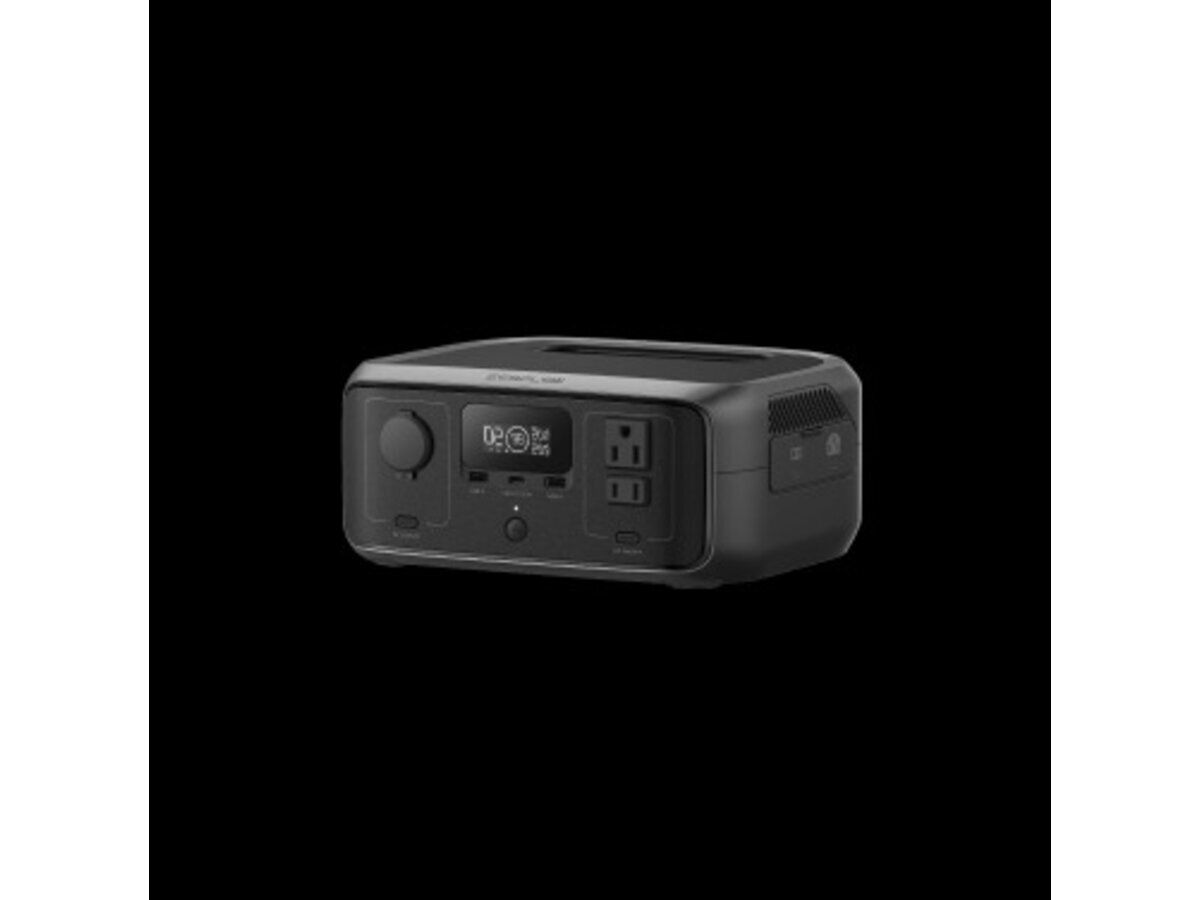
EcoFlow RIVER 3
Ultralight 245 Wh travel companion with X-Boost up to 600 W on a 300 W inverter.
Prices last verified: data file timestamp. Affiliate links — see disclosure below.
Expert Review
- ✓Impressively fast charging for its class — full in about 1 hour from a wall outlet
- ✓LiFePO4 chemistry rated for 3000 cycles, more than double most NMC entry units
- ✓Compact and light at under 8 lbs — easily fits in a carry-on or day pack
- ✗Limited to 245 Wh — single overnight CPAP use or 2–3 laptop charges per cycle
- ✗No expandable battery option; what you buy is what you get
Design & Build Quality
The EcoFlow River 3 ditches the original River's rounded corners for a sharper-edged rectangular body that stacks neatly in a pack or shelf. The grey-and-black colorway is understated and professional. A single top handle is comfortable for short carries. Ports are organized cleanly on the front panel: two AC outlets, two USB-A, one USB-C, and a car outlet. The LDC display is small but clear, showing battery percentage, input/output wattage, and estimated runtime. At 7.7 lbs, it is genuinely easy to carry with one hand all day.
Performance & Test Results
Despite its small capacity, the River 3 punches above its weight in performance. HoboTech tested AC-to-full in approximately 58 minutes — a legitimately fast result for this price bracket. Real-world capacity measured around 218 Wh at full AC load (89% of spec), consistent with EcoFlow's LFP cells running efficiently. The 600 W continuous AC output is sufficient for a CPAP (35–80 W), laptop (45–65 W), or small LED lamp. It cannot run appliances with heating elements or large motors. Fan noise is minimal — around 38 dB — which makes it suitable for bedside CPAP use. The X-Stream fast charge works via USB-C too, pulling up to 65 W for laptop charging.
Value Verdict
The River 3 is the right tool for a specific job: one-night CPAP backup, desk charging while camping, or keeping phones and tablets running during a short outage. Its LFP chemistry means you'll still have useful capacity in 5–7 years of regular cycling. It is not suitable for running a fridge, powering tools, or extended emergency backup. Compared to older NMC entry units at similar prices, the 3000-cycle rating makes the River 3 a far better long-term value for light but regular use.
Will it run your stuff? Scenario runtimes
Realistic estimates using LiFePO4 efficiency (~88%) and 92% usable capacity. Not best-case marketing numbers.
| Device / scenario | Draw | Runtime |
|---|---|---|
| Tent & weekend camping LED lantern |
5 W | 39h 40m |
| Phone charging (2 phones) | 20 W | 9h 55m |
| 12 V cooler | 50 W | 3h 58m |
| Camp fan | 25 W | 7h 56m |
| Drone battery charge | 80 W | 2h 29m |
| Home backup during blackout Refrigerator (avg with cycling) |
120 W | 1h 39m |
| Internet router + modem | 15 W | 13h 13m |
| LED lighting (6 bulbs) | 45 W | 4h 24m |
| Phone + laptop charging | 60 W | 3h 18m |
| Microwave (brief use) | 1100 W | 11 min |
| Overnight CPAP CPAP without humidifier |
35 W | 5h 40m |
| CPAP with heated humidifier (low) | 80 W | 2h 29m |
| CPAP with heated humidifier (high) | 120 W | 1h 39m |
| BiPAP | 55 W | 3h 36m |
| RV / van life 12 V RV fridge |
60 W | 3h 18m |
| Roof fan | 30 W | 6h 37m |
| LED interior lights | 25 W | 7h 56m |
| Induction cooktop (one burner, brief) | 1200 W | 10 min |
| Laptop charging | 65 W | 3h 3m |
| Refrigerator power Mini fridge (compressor) |
80 W | 2h 29m |
| Full-size fridge (compressor avg) | 120 W | 1h 39m |
| Chest freezer | 100 W | 1h 59m |
| Wine fridge | 90 W | 2h 12m |
Full specifications
| Battery | |
|---|---|
| Capacity | 245 Wh |
| Chemistry | LiFePO4 |
| Cycles to 80% | 3,000 |
| Expandable max | Not expandable |
| Inverter | |
| Continuous output | 300 W |
| Surge / peak | 600 W |
| Pure sine wave | Yes |
| UPS switchover | 30 ms |
| X-Boost | up to 600 W (low-watt resistive loads) |
| Charging | |
| AC max input | 268 W |
| AC recharge | ~1 hr |
| Solar max input | 110 W |
| Solar voltage range | 11-30V |
| Solar connector | XT60 |
| Ports | |
| AC outlets | 3 |
| USB-A | 2 |
| USB-C | 1 (max 100 W) |
| 12V car socket | 1 |
| Low-amp DC | 0 |
| Wireless charging pad | No |
| Physical | |
| Weight | 7.8 lbs (3.5 kg) |
| Dimensions | 10.0 x 8.3 x 4.4 in |
| Warranty | 5 years |
| Connectivity | |
| App / wireless | WiFi, Bluetooth |
| Real-world tests | |
| Real measured capacity | 232 Wh (95% of spec) |
| Real measured AC continuous | 295 W at sustained load |
| Noise at 50% load | 30 dB |
| Spec Reality Score | 94/100 |
Frequently asked questions
Will the EcoFlow RIVER 3 run a CPAP machine overnight?
A standard CPAP without heated humidification draws about 35 W. The RIVER 3's 245 Wh real-world capacity gives you roughly 5h 40m — comfortably more than one 8-hour night. With heated humidification on (around 80 W), drop that to about 2h 29m.
Can the EcoFlow RIVER 3 power a refrigerator during a blackout?
Marginal. The 600 W surge rating sits below the 1,200 W spike a typical full-size fridge compressor needs to start. It works for compact mini-fridges and DC compressor fridges (which surge under 400 W), but a standard 18 cu ft kitchen fridge will trip the inverter on startup. For full-size refrigerator backup, look at a 1,500+ W unit.
How long can the RIVER 3 charge phones, tablets, and laptops?
Phones (10 W): roughly 20 full charges. A laptop on continuous use at 65 W: about 3h 3m, or 3–4 full charge-and-go cycles. Tablets land between phones and laptops — most fully charge from about 15–25 Wh per session.
How long does it take to fully recharge the RIVER 3?
From a wall outlet (268 W max input): around 1 hour. From a 12 V car port: 8–12 hours (slow trickle). From a 110 W portable solar panel in good sun: roughly 4 hours of direct sunlight, which usually translates to one solid summer day or two cloudy ones.
How many years will the battery last?
The LiFePO4 cells inside the RIVER 3 are rated for 3,000 full cycles before degrading to 80% capacity. Cycle it daily (heavy use) and that's around 8 years. For typical occasional use — say, 1–2 cycles a week for weekend trips and the occasional blackout — you're looking at 15+ years before noticeable capacity loss. The bigger limitation in practice is the inverter and BMS electronics, which usually go before the cells do.
Does it accept solar input?
Yes — up to 110 W via XT60 connector. Voltage range 11-30V. Compatible with most portable folding solar panels in the 100–110 W range; check that the panel's open-circuit voltage stays within the listed range. Our solar pairing calculator will tell you how long a specific panel takes to refill.
Can the RIVER 3 act as a UPS for a desktop PC or NAS?
Yes. Switchover from grid to battery is 30 ms, fine for most home electronics but borderline for picky older desktops that may reboot on gaps above 20 ms. Plug your device into the AC outlet, then plug the power station's own AC input into the wall. The unit passes grid power through until it drops, then switches to battery.
What's the warranty?
5 years on battery and main unit, covering manufacturing defects and capacity degradation below the rated cycle count. Doesn't cover physical damage, water exposure, or unauthorized opening. Register the unit with EcoFlow within 30 days of purchase to activate.
Sources & further reading
- HoboTech Independent Review & Load Test: EcoFlow RIVER 3 — YouTube (HoboTech)
- EcoFlow RIVER 3 Hands-On Review — TechRadar
Heads up: Some links on this page are affiliate links (marked with the partner). If you buy through them we earn a small commission — at no cost to you — which keeps the lights on. We don't get paid more for any specific recommendation.