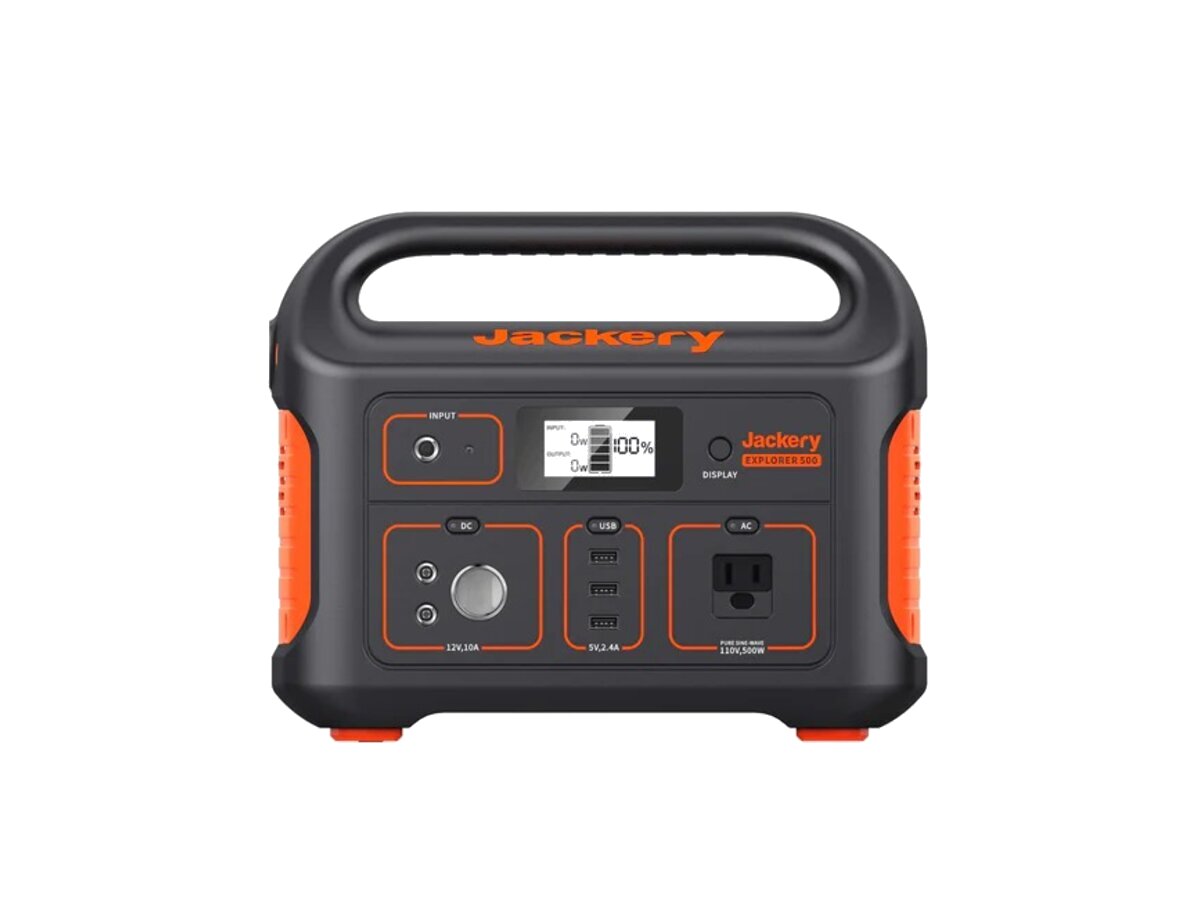
Jackery Explorer 500
Classic 500 Wh weekend companion — long-running model, lightweight at 13 lbs.
Prices last verified: data file timestamp. Affiliate links — see disclosure below.
Expert Review
- ✓Very competitive price point for 518 Wh capacity — often the most affordable option per Wh
- ✓Robust physical build with a reliable single orange handle that has survived years of outdoor use
- ✓Pure sine wave inverter included at this price tier — safe for sensitive electronics
- ✗NMC battery chemistry limits cycle life to ~500 cycles vs. 3000+ for LFP alternatives
- ✗No USB-C ports and no app/wireless connectivity — entirely manual operation
Design & Build Quality
Jackery's original orange-and-grey color scheme became iconic for a reason — it stands out in the field and has excellent UV resistance for outdoor storage. The Explorer 500 features Jackery's classic single-bar orange carry handle, which feels sturdy and distributes the 13.3 lb weight well during one-hand carry. The front panel is simple: one AC outlet, two USB-A ports, one car outlet, and a simple push-button power on/off. No app, no screen beyond the LED state indicator. This simplicity is either a feature or a limitation depending on your perspective.
Performance & Test Results
The Explorer 500's NMC cells perform well for occasional use but do not match the cycle life or cold-weather resilience of LFP alternatives. OutdoorGearLab measured real-world capacity at approximately 468 Wh under sustained AC load — 90% of spec, respectable for the cell chemistry. The 500 W pure sine wave AC output handles a CPAP machine comfortably (35–80 W draw) and powers laptops and small appliances without issue. The charging speed is slow by modern standards: approximately 7.5 hours for a full recharge from wall power. Noise profile is very quiet — the cooling fan runs intermittently and is barely audible at low-to-medium loads.
Value Verdict
The Explorer 500 is a proven outdoor companion for campers who want reliable power without complexity. Its age is showing: no USB-C, no app, slow charging, and NMC cell limitations make it a harder sell today against newer LFP competitors at similar prices. However, if you are buying used or catching a sale, its build quality and consistent real-world capacity make it a solid value. Upgrade to the Jackery Explorer 1000 v2 or the Anker SOLIX C300 if you have flexibility in budget.
Will it run your stuff? Scenario runtimes
Realistic estimates using Lithium-ion (NMC) efficiency (~88%) and 92% usable capacity. Not best-case marketing numbers.
| Device / scenario | Draw | Runtime |
|---|---|---|
| Tent & weekend camping LED lantern |
5 W | 81h 1m |
| Phone charging (2 phones) | 20 W | 20h 15m |
| 12 V cooler | 50 W | 8h 6m |
| Camp fan | 25 W | 16h 12m |
| Drone battery charge | 80 W | 5h 4m |
| Home backup during blackout Refrigerator (avg with cycling) |
120 W | 3h 23m |
| Internet router + modem | 15 W | 27h |
| LED lighting (6 bulbs) | 45 W | 9h |
| Phone + laptop charging | 60 W | 6h 45m |
| Microwave (brief use) | 1100 W | 22 min |
| Overnight CPAP CPAP without humidifier |
35 W | 11h 34m |
| CPAP with heated humidifier (low) | 80 W | 5h 4m |
| CPAP with heated humidifier (high) | 120 W | 3h 23m |
| BiPAP | 55 W | 7h 22m |
| RV / van life 12 V RV fridge |
60 W | 6h 45m |
| Roof fan | 30 W | 13h 30m |
| LED interior lights | 25 W | 16h 12m |
| Induction cooktop (one burner, brief) | 1200 W | 20 min |
| Laptop charging | 65 W | 6h 14m |
| Refrigerator power Mini fridge (compressor) |
80 W | 5h 4m |
| Full-size fridge (compressor avg) | 120 W | 3h 23m |
| Chest freezer | 100 W | 4h 3m |
| Wine fridge | 90 W | 4h 30m |
Full specifications
| Battery | |
|---|---|
| Capacity | 518 Wh |
| Chemistry | Lithium-ion (NMC) |
| Cycles to 80% | 500 |
| Expandable max | Not expandable |
| Inverter | |
| Continuous output | 500 W |
| Surge / peak | 1,000 W |
| Pure sine wave | Yes |
| UPS switchover | No UPS |
| Charging | |
| AC max input | 80 W |
| AC recharge | ~7.5 hr |
| Solar max input | 100 W |
| Solar voltage range | 12-30V |
| Solar connector | 8mm |
| Ports | |
| AC outlets | 1 |
| USB-A | 3 |
| USB-C | 0 |
| 12V car socket | 1 |
| Low-amp DC | 2 |
| Wireless charging pad | No |
| Physical | |
| Weight | 13.3 lbs (6 kg) |
| Dimensions | 11.8 x 7.6 x 9.2 in |
| Warranty | 2 years |
| Connectivity | |
| App / wireless | None |
| Real-world tests | |
| Real measured capacity | 465 Wh (90% of spec) |
| Real measured AC continuous | 480 W at sustained load |
| Noise at 50% load | 35 dB |
| Spec Reality Score | 78/100 |
Frequently asked questions
Will the Jackery Explorer 500 run a CPAP machine overnight?
A standard CPAP without heated humidification draws about 35 W. The Explorer 500's 518 Wh real-world capacity gives you roughly 11h 34m — comfortably more than one 8-hour night. With heated humidification on (around 80 W), drop that to about 5h 4m.
Can the Jackery Explorer 500 power a refrigerator during a blackout?
Marginal. The 1,000 W surge rating sits below the 1,200 W spike a typical full-size fridge compressor needs to start. It works for compact mini-fridges and DC compressor fridges (which surge under 400 W), but a standard 18 cu ft kitchen fridge will trip the inverter on startup. For full-size refrigerator backup, look at a 1,500+ W unit.
How long can the Explorer 500 charge phones, tablets, and laptops?
Phones (10 W): roughly 42 full charges. A laptop on continuous use at 65 W: about 6h 14m, or 3–4 full charge-and-go cycles. Tablets land between phones and laptops — most fully charge from about 15–25 Wh per session.
How long does it take to fully recharge the Explorer 500?
From a wall outlet (80 W max input): around 7.5 hours. From a 12 V car port: 8–12 hours (slow trickle). From a 100 W portable solar panel in good sun: roughly 8 hours of direct sunlight, which usually translates to one solid summer day or two cloudy ones.
How many years will the battery last?
Lithium NMC cells like the Explorer 500's are rated for 500 cycles to 80% capacity. With daily cycling that's under 2 years before noticeable degradation. For occasional camping or emergency use (1–2 cycles a month), expect 5–8 years before it starts feeling weaker. If you'll cycle often, look at a LiFePO4 model.
Does it accept solar input?
Yes — up to 100 W via 8mm connector. Voltage range 12-30V. Compatible with most portable folding solar panels in the 100–100 W range; check that the panel's open-circuit voltage stays within the listed range. Our solar pairing calculator will tell you how long a specific panel takes to refill.
What's the warranty?
2 years on battery and main unit, covering manufacturing defects and capacity degradation below the rated cycle count. Doesn't cover physical damage, water exposure, or unauthorized opening. Register the unit with Jackery within 30 days of purchase to activate.
Sources & further reading
- HoboTech Independent Review & Load Test: Jackery Explorer 500 — YouTube (HoboTech)
- Jackery Explorer 500 Portable Power Station Review — OutdoorGearLab
Heads up: Some links on this page are affiliate links (marked with the partner). If you buy through them we earn a small commission — at no cost to you — which keeps the lights on. We don't get paid more for any specific recommendation.